Showing posts with label black tiger swallowtail. Show all posts

Monday, September 15, 2025

another fawn on the lawn

 Is it possible?  Yes!  Even more beautiful caterpillars!

turbulent phosila moth caterpillars

black tiger swallowtail butterfly caterpillar

This silver-spotted skipper caterpillar has impaled itself on the thorns of this tree branch!  The black liquid you see is hemolymph, its blood.  He's probably a goner.


This tussock moth caterpillar is not doing much better.  The photo isn't great, but you can see that a braconid wasp has deposited eggs that developed into larvae.  The larvae spun these little white cocoons.  Some of the tops are off...that means that the larvae developed into wasps and chewed free.


Here's a bagworm caterpillar...a real pest.


And evidence of the caterpillar that once was...here's a recent molt!


Some other standouts this week...an American giant millipede!


These two Virginia tiger moths are mating before the cold weather hits.


This pelecinid wasp looks scary, but that ominous abdomen isn't for stinging humans...it's for depositing eggs into June beetle larvae.  


Our injured buck was back this week...


...and he brought a friend!


The weather has turned hot again, which you can see in heat-stressed plants...


...and sun-loving cats.


I'm not a fan.  Bring on fall!!


At least our morning walks are still cool.  A big of steam rises from the pond...


...and we're nicely shaded from the sun.


Despite the dry weather, I've seen some really beautiful mushrooms.

indigo milk cap...edible!

the aptly-named dog vomit fungus

Do you remember these lynx paw oyster mushrooms from a few weeks ago?


They matured quickly, and were soon covered in hundreds of tiny flies!


The mushroom excretes a stinky gel that attracts flies.  The flies come, eat the gel, and manage to ingest some of the mushroom's spores.  They then drop them far and wide, aiding in the spread of this species.  Pretty smart!  

Even though we have late-season roses now...


I'm so ready for the weather change.  We'll see what happens.

Have a great week!  


Tuesday, September 10, 2013

Elementary, my dear Watson...

There are, I think, two keys to successfully observing wild creatures in their native habitats.  One is patience.  Many times I've taken my camera to a place with no visible activity and sat quietly.  Insects start bustling about within five minutes, then come the butterflies, and next the birds and squirrels.  Another important key, though, is being able to spot clues that creatures leave behind.

I saw this dessicated cricket caught up in the fern fronds on our front porch.


Instantly, my mind was racing.  What eats crickets?  Well, birds, snakes, reptiles, spiders, frogs, and fish.  But since this was on the front porch, it would have to be a spider...or a mantis.


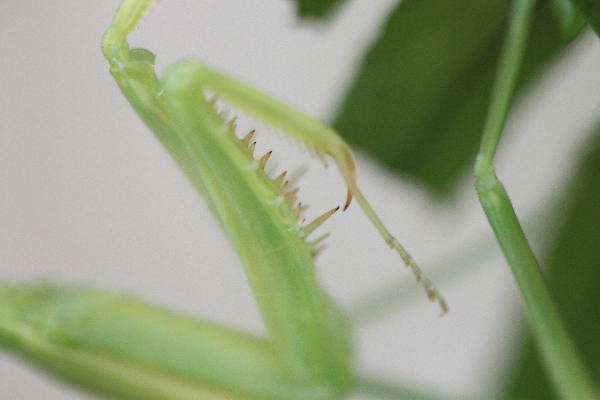
Sure enough, a praying mantis was lurking nearby.  It seemed smaller and more delicate than the big mantises I'm used to in Indiana, with a stubbier abdomen and beautiful lacy wings.


Of course, it had the characteristic of all mantises, who are efficient killers:  those long, serrated forelegs.


They never stop watching you.  Insects are so unbelievably aware of our presence, all the time.


Here's another example.  We've had many fine sunny days lately, and I've been able to spend more time outside.  Last week, I saw some droppings on a canna leaf.


The size told me it was too big for an insect, and it wasn't runny enough for a bird (TMI?).  I suspected it might be a lizard, and I found him before too long, hiding on the same plant.


I haven't seen many anoles this summer.  I wonder if they're more prevalent in the fall here?


Despite the black aphids, those chives I'd feared lost earlier this month bloomed nicely.


They drew all sorts of attention.  Bees...


Ants...


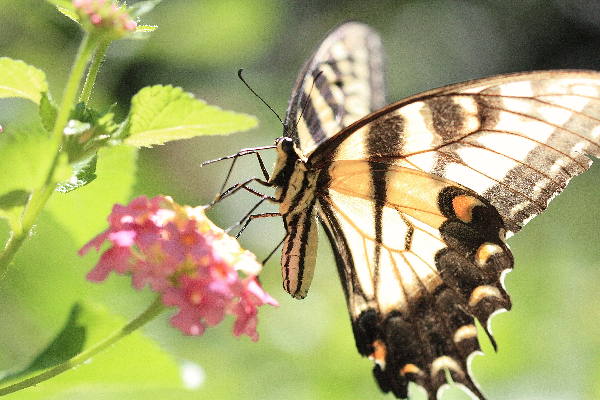
And even butterflies, although they mainly stayed with the butterfly bushes and lantana.  Black tiger swallowtails and eastern tiger swallowtails are the most common.


The air is filled with little red fluttering things, but they aren't ladybugs like I initially thought.  They're related to leaf hoppers and look very similar, but they're actually (two-lined) spittle bugs.


They can be disastrous to lawns, feeding on the turf grasses that are common here in the South.  We haven't had any trouble, but we'll have to keep a close watch!

Speaking of lined, a huge striped fly landed on one of our windows recently.  He had what I call "Halloween legs" and must've been a full two inches long.


I was never able to figure out what he was!  If anyone knows...

Anyway, I encourage you to grab your magnifying glass and put on your deerstalker (that's the type of hat that Sherlock Holmes wore!), and see what you can find in your own yard with a little deductive reasoning and patience.

Have a great week!