My tiger lilies are doing well, too. I bought one limp lily clearanced to .99 several years ago and planted it. The second year, a few small lilies came up, but each year, they grow and spread nicely.
 The ditch lilies are up, too! Ditch lilies, or Hemerocallis fulva, are great for poor-soil areas. You may have seen great patches of them along the highway, hence their nickname. They thrive without attention in dry soil and full sun, so are perfect for areas of your yard that other things won't grow in. Be cautious, though. They don't play well with others and will quickly choke out competing plants in their vicinity.
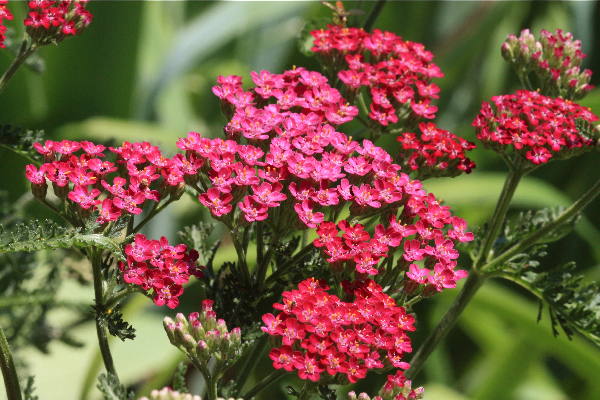
 My yellow yarrow had its first blush of color recently.
 My favorite, though, is the hot pink. Each year the patches grow and spread. I can't imagine my garden without these colorful plants.
 The feverfew bush is blooming...
 ...and I've gotten the first bloom on my "Endless Summer" hydrangea.
 I love seeing all the individual petals unfurling.
 The small dill patch from last year came back and spread with a vengeance. Dill seeds insinuated themselves into the cracks in our concrete driveway and grew rapidly. They smell delicious when you back over them! :) Thankfully, we have dill all along the fence line, too.
 The first zinnia bud has appeared...
 ...as has the first cosmos bud.
 My mallows have grown nicely and are just starting to go to seed. I planted cosmos around the mallows to provide a nice leafy 'cover' for the ground, and so that I'd patches of tall orange flowers to cover up the stalks when they go to seed.
 Like every year...a surprise! I've got 6 or 7 larkspur plants growing in various parts of the garden. How did they get there? I don't know, but I'm really enjoying them while they last! An interesting fact: giving someone a specific type of flower denotes a particular meaning...i.e., a carnation means friendship, etc. Be careful who you give a larkspur to, though...larkspurs signify fickleness!
 Insects have had quite a time with my flowers this year. I don't recall it ever being so bad before. The leaves on most of my zinnias have been eaten down.
 My oriental lilies have fallen prey to another invasive insect, which has swarmed all over the leaves and buds, causing them to shrivel.
 I don't use pesticides on my plants. Thankfully - I think - I've got more praying mantises than ever before. Another ootheca has hatched recently. These tiny mantis nymphs are still swarming all over the area near where they hatched from. They'll eat many, many garden pests.
 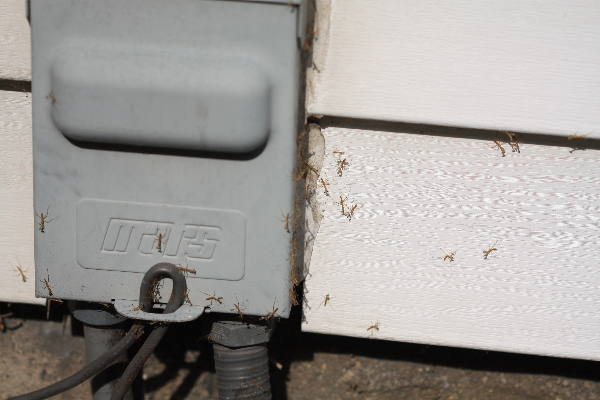 In another part of the garden, this young praying mantis, from a different ootheca, looks alert on a leaf.
 A lightning bug rests up for his nighttime performance. I've always loved lightning bugs and miss seeing them...there are so few of them in the city, compared to what I am used to in the country. I've read that lightning bugs are fast disappearing. Human encroachment on their habitats - woods and meadows - have decreased their numbers, but they also suffer from something called 'light pollution'. Lightning bugs communicate with each other with the flashing light of their abdomens. They can get confused with all the lights they see - headlights, lights from houses, street lights - and become unable to signal properly for a mate. That's why I love having big, messy gardens with pesticide-free insect control like (shudder) praying mantises...not only it is beautiful to me, but it can provide a safe haven for all types of insects.
 Spiders are another great form of insect control. I found a large funnel web spider web behind my phlox. I know that like praying mantises, spiders are good to have in a garden. I'm still a little afraid of them, though, especially aggressive ground spiders like wolf spiders.
 I seem to be obsessed with hover flies lately. I've bee photographing them on the yarrow...
 ...the feverfew...
 ...and on random leaves and stems. I can't help it...I think they're quite beautiful, with their tidy proportions, nicely lined wings, and evenly patterned abdomens.
 Being on vacation recently gave me a chance to start a new knitting project. I wanted to make a slouchy hat in one of my favorite colors, mustard. This hat was designed by a Scottish woman who was born in the Shetland Islands and who recently released a book of patterns inspired by her life there. This particular hat uses a traditional lace pattern called 'cat's paw'. It didn't look like much after I finished it, but therein lies the magic of blocking.
 One supper plate later...
 ...and voila! It's a perfect fit, and comfortably slouchy. I can see grabbing this hat in the fall, just before a long, brisk walk.
 Another knitter sent me a surprise package this week, of vintage buttons. I love buttons of all kind, and these were beauties...pearly pinks, silvery bell-like circles, faux diamonds, some that looked like burnished steel, deep reds, pale greens, and calming blues...and a whole hodgepodge of whites, creams, browns, blacks, and bronzes.
 I was glad to have a little surprise, because I needed a pick-me-up. Todd is out of town again, and I absolutely feel miserable when he's gone. He'll be home soon, though, and meanwhile I have lots to keep me busy...
Enjoy your week!


 Posts
Posts